
Parking Lot and Garage Power Washing in NYC: Oil Stains, Road Salt, and Local Law 126
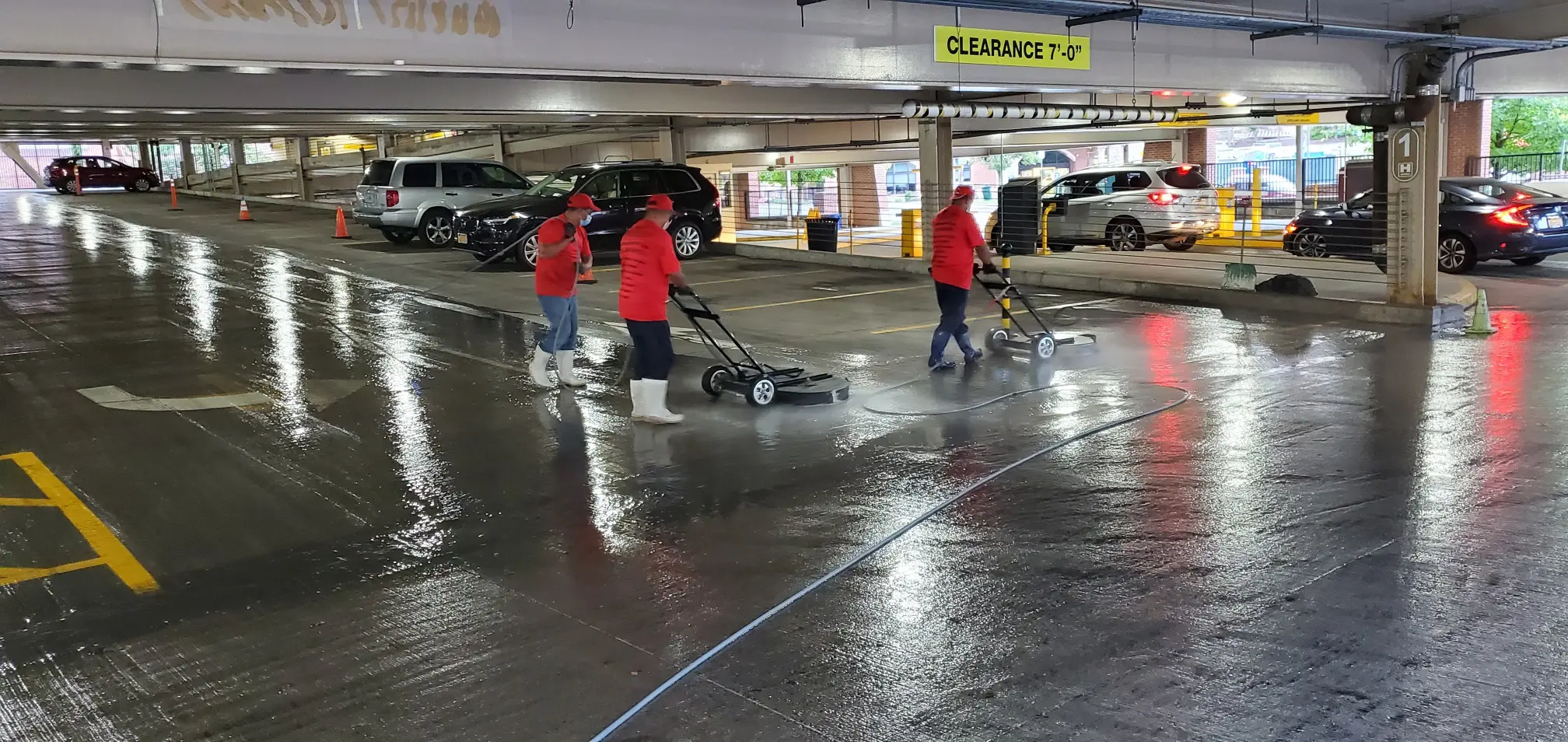
Quality Power Wash Team | August 2026
Most NYC parking structures should be washed at least twice a year, once after the winter salt season and once in the fall, and open lots need sweeping far more often than they need washing. But the reason to do it is not appearance. It is that chloride from road salt corrodes the reinforcing steel inside your slab, and that a Local Law 126 inspector cannot examine a deck he cannot see.
This guide covers what actually damages a NYC garage, what the city requires, where the wash water is legally allowed to go, and what a real parking lot and garage cleaning program costs and includes.
1. Road Salt Is Not a Stain. It Is a Corrosion Problem
Concrete protects embedded steel because its high alkalinity maintains a passive oxide film on the rebar. Chloride ions break that film down. Federal Highway Administration research notes that active corrosion can begin at chloride concentrations at the steel depth as low as roughly 0.6 kilograms per cubic meter of concrete. Once corrosion starts, the corrosion products expand, and that expansion is what produces the cracking and spalling you see on aging decks.
FHWA studied bridges rather than garages, but the failure mode is identical: a horizontal reinforced concrete deck, exposed to de-icing salt, holding wet chloride against the slab for months. A NYC garage floor gets a fresh dose every time a car drives in during January. Rinsing that chloride off in the spring is the cheapest structural maintenance you will ever buy. Restoration engineers commonly recommend a wash at the spring thaw and again in the heart of fall.
2. Local Law 126: Why Cleaning Before the Inspection Is Not Cosmetic
Local Law 126 of 2021 created the Periodic Inspection of Parking Structures program. Owners of covered parking structures must retain a New York State licensed professional engineer who is also a Qualified Parking Structure Inspector to perform a condition assessment every six years, filed through DOB NOW within 60 days of completion, with an annual observation by the owner in between using a checklist the inspector prepared.
The rule requires hands on physical examination, including sounding, probing, and testing, on a minimum of 10 percent of each structural element, and states that the methods used must permit a complete physical examination. You cannot sound a slab for delamination, map a crack, or verify a drain through a layer of oil film, salt crust, and tire rubber. That is the practical argument for washing before the inspector arrives.
Sub-cycle | Where | Filing window |
|---|---|---|
1A | Manhattan Community Districts 1 to 7 | Closed. Next window opens January 1, 2028 |
1B | Manhattan CDs 8 to 12 and all of Brooklyn | Closed December 31, 2025. Late filers are accruing penalties now |
1C | Bronx, Queens, and Staten Island | Open now, January 1, 2026 through December 31, 2027 |
Penalties are real. In January 2024 DOB announced that over 400 property owners faced penalties for late reports, at $1,000 initially, $1,000 per month it remains unfiled, and $5,000 at year end, which is $17,000 over a year. Unsafe conditions must be repaired within 90 days of filing, with an amended report within two weeks.
- Covered: buildings or portions of buildings used for parking or storing motor vehicles, open or enclosed
- Exempt: auto body shops, showrooms, garages holding fewer than three cars, service stations, repair shops, one and two family private garages, and unenclosed, unattached lots
- Important: an open striped surface lot is generally exempt. The Local Law 126 angle applies to structures, not to asphalt.
Confirm your building’s sub-cycle and status on the DOB parking structure page before acting on these dates.
We wash garages level by level and overnight so the structure keeps earning while we work. Call 718-986-8129 or request a free quote for a walkthrough.
718-986-8129
3. Where the Water Goes Is a Legal Question
NYC rules state that no person shall discharge, directly or indirectly, into any storm sewer any substance other than stormwater or allowable runoff, and the same prohibition covers catch basins and manholes. A connection to the sewer system by pipe, hose, or channel requires the written approval of the Commissioner.
Separate storm sewers serve roughly a third of New York City, and in those areas runoff goes to local waterways essentially untreated. The rest of the city is on a combined system. The rule does not carve out combined sewer catch basins, so the safe operating assumption is that oily wash water never goes down a grate anywhere in the city without DEP approval.
To be clear about what is not true: you generally do not need a permit to power wash your garage. NYC’s industrial wastewater discharge permit is triggered by industry category or by volume, and a typical deck wash will not approach the volume threshold. What you need is containment and recovery. That means drain plugs and mats, berms, vacuum booms, and recovery tanks, with the filtered water disposed of properly. If a bidder cannot describe their recovery method, the liability for what runs into that catch basin is yours, not theirs.
4. What Actually Comes Off, and How
- Oil and fluid stains: concrete is porous, so over weeks oil migrates into the capillary structure. Old stains need heat, dwell time, and sometimes an absorbent poultice, not more PSI. Be realistic: a five year old stain lightens, it does not vanish.
- Emulsifiers versus degreasers: a degreaser lifts the oil, an emulsifier suspends it in the water so it can be recovered. In a garage where every gallon has to be vacuumed back up, emulsification is what keeps the oil in the recovery tank instead of in your drain.
- Tire marks: rubber transfer responds to solvent chemistry plus heat, not pressure.
- Efflorescence: the white crystalline bloom is a symptom of water migrating through the concrete, so it flags a waterproofing issue your inspector will care about. Removed with a mild acidic wash, not blasted.
- Pigeon droppings: treated as a biohazard, not a stain. Never dry sweep or blast dry droppings, because that aerosolizes them. Wet down first, with proper PPE.
- Drains: two separate jobs. Protect the drain during the wash, then clear it afterward. Clogged deck drains cause ponding, and ponding accelerates freeze thaw and chloride penetration.
- Lighting: grime on fixtures and lenses cuts light output substantially. A dark, oil slicked deck is a premises liability claim waiting to happen, and lighting is among the appurtenances an inspector reviews.
Not every problem is a water problem. Mechanical sweeping and ride on scrubbers handle grit, sand, and litter with almost no water, which is the right call in winter and in decks with poor drainage. Washing and sweeping are complementary, not interchangeable. Our pressure washing services page covers the equipment side, and the surfaces we clean page covers substrate by substrate method.
5. Keeping the Garage Open While You Clean It
A garage is a revenue asset, and shutting it down for a day is usually more expensive than the wash. The workable approach is level by level or half deck phasing, executed overnight, coordinated with the operator so no revenue day is lost. On open lots, work has to fit around alternate side parking and tenant traffic instead.
One thing worth bundling: schedule re-striping immediately after the wash. Washing exposes faded lines, and the surface is never better prepped for paint adhesion than right after it has been cleaned. Stall lines, ADA markings, directional arrows, numbering, and bollard or curb painting all go in the same mobilization.
6. Frequency and Budget
Property | Wash frequency | Notes |
|---|---|---|
High traffic urban or retail garage | Quarterly | Constant fluid drips and heavy foot traffic |
Office or residential garage | 2 times per year | Spring salt strip plus a fall wash |
Low traffic structure | Annually, plus spring | Never skip the post winter chloride rinse |
Open surface lot | Sweep monthly to quarterly, wash 1 to 2 times per year | Rain does part of the work a garage never gets |
Dumpster and loading areas | Monthly | Odor and pest pressure, not appearance |
On price, national aggregators put commercial garage and structure washing at roughly $0.03 to $0.25 per square foot, and parking lots at roughly $8 to $20 per parking space, with general commercial work running $0.10 to $1.00 per square foot depending on how contaminated the surface is. NYC sits at the higher end of those ranges, and no published figure accounts for the things that actually move a NYC number: overnight work, water source, containment and recovery requirements, access, and low ceiling height. Treat the ranges as orientation, then get a walkthrough. Our NYC commercial pressure washing cost guide goes deeper on what drives the number.
Final Thoughts
A parking deck is the one part of a building that is simultaneously a structural element, a revenue center, and a liability exposure. Washing it is how you slow chloride corrosion, how you let an inspector do the examination the law requires, and how you keep a dark, slick deck from becoming a claim. Two visits a year, water recovered rather than flushed, phased so you never close, is the program most NYC properties should be running.
We serve garages, lots, and structures for property managers, office buildings, and apartment complexes across all five boroughs.
Frequently Asked Questions
How often should a parking garage be power washed?
Twice a year suits most NYC structures: once right after the winter salt season to strip chloride off the slab, and once in the fall. High traffic urban and retail garages benefit from quarterly service. Open surface lots need sweeping monthly to quarterly and a full wash once or twice a year, since rain does some of the work a covered deck never gets.
Is it legal to let power washing water go down a storm drain in NYC?
No. NYC rules prohibit discharging anything other than stormwater or allowable runoff into a storm sewer, catch basin, or manhole, and a sewer connection requires written approval from the Commissioner. Roughly a third of the city is on separate storm sewers that flow to local waterways untreated. The compliant approach is containment and vacuum recovery, then proper disposal.
Do I need to clean my garage before a Local Law 126 inspection?
It is not required by the rule, but it is practical. The inspection requires hands on physical examination, including sounding and probing, on at least 10 percent of each structural element, and the methods used must permit a complete physical examination. Oil film, salt crust, and tire rubber conceal exactly the cracking, spalling, and drainage problems the inspector is looking for.
Does pressure washing actually remove old oil stains from concrete?
It lightens them substantially, but be realistic about a stain that has been soaking in for years. Concrete is porous, and oil migrates deep into the capillary structure. The tools that work are heat, an emulsifying degreaser with real dwell time, and sometimes an absorbent poultice to draw the oil back out. More pressure does not help and can damage the surface.
Does road salt really damage a concrete parking garage?
Yes, and the damage is structural rather than cosmetic. Chloride ions break down the passive film that protects the reinforcing steel inside the concrete. Federal Highway Administration research notes corrosion can begin at chloride levels at the steel depth as low as about 0.6 kilograms per cubic meter. The corrosion products expand, which is what causes cracking and spalling in aging decks.
Quality Power Wash cleans parking garages, decks, and lots across NYC with full water recovery and overnight phasing. Call 718-986-8129 or contact Quality Power Wash for a free quote.
718-986-8129