
Facade Cleaning and Local Law 11 in NYC: What Building Owners Should Know in 2026
Quality Power Wash Team | August 2026
Straight answer first: the Department of Buildings does not require you to clean your facade. There is no washing or surface preparation requirement anywhere in the Facade Inspection Safety Program rule. Any contractor who tells you cleaning is mandatory for Local Law 11 is selling, not informing.
What is true is more useful. FISP requires an engineer to physically examine your wall from arm’s length, and carbon soiling, biological growth, and efflorescence crusts hide exactly the hairline cracks, incipient spalls, displaced units, and open mortar joints he is looking for. Cleaning is also the standard first step before repointing, because mortar and sealants bond poorly to soiled masonry. Here is how the compliance calendar and the cleaning work actually fit together.
1. What Local Law 11 / FISP Actually Requires
- Which buildings: all existing buildings greater than six stories in height. Note that it is stories, not feet, and it is greater than six, so a seven story building is covered and a six story building is not.
- How often: a critical examination every five years
- By whom: a Qualified Exterior Wall Inspector, meaning a New York State licensed professional engineer or registered architect in good standing
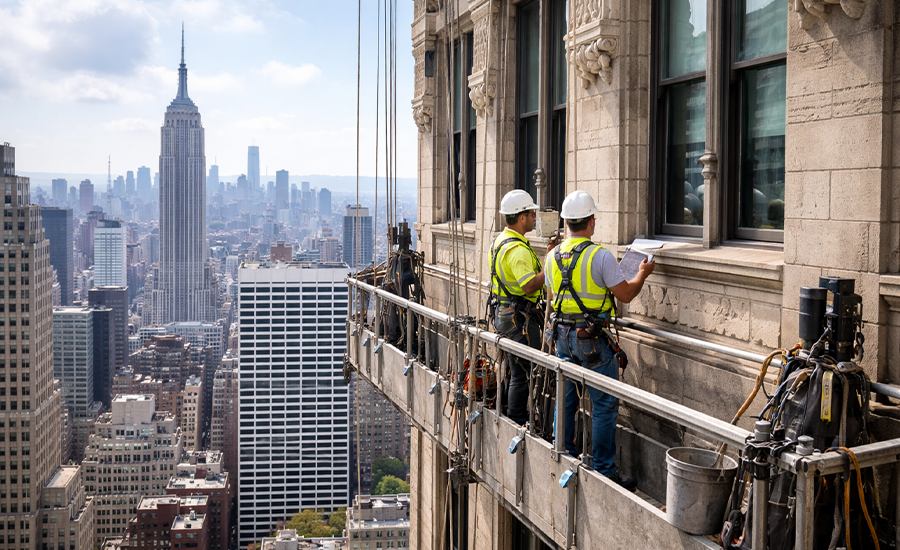
- How: close-up physical examination from scaffolding or an observation platform at intervals of not more than 60 feet, along a path from grade to the top of each exterior wall fronting a public right of way, with at least one scaffold drop per elevation. Drones, high resolution photography, and non destructive testing supplement that requirement, they do not replace it.
That close-up requirement is the whole reason cleaning matters. An inspector standing three feet from your wall cannot assess what a century of traffic soot is covering.
2. Cycle 10 Deadlines, by Tax Block Number
Cycle 10 runs from February 21, 2025 to February 21, 2030, and your filing window depends on the last digit of your tax block number, not your address or borough.
Sub-cycle | Tax block ends in | Filing window | Status in August 2026 |
|---|---|---|---|
10A | 4, 5, 6, 9 | Feb 21, 2025 to Feb 21, 2027 | Open, roughly six months left |
10B | 0, 7, 8 | Feb 21, 2026 to Feb 21, 2028 | Open |
10C | 1, 2, 3 | Feb 21, 2027 to Feb 21, 2029 | Not yet open |
If you are in 10A and have not retained a QEWI, that is the item to move on this quarter, because scaffold rigging and inspector availability, not paperwork, are what run out of time. Owners still carrying a No Report Filed status from Cycle 9 may file an initial Cycle 10 report early, before their window opens, to stop civil penalties from accruing. Confirm your own block number and status on the DOB facade page before you rely on these dates.
3. Safe, SWARMP, and Unsafe: What Each One Costs You
- Safe: no repair or maintenance needed to sustain structural integrity, and the wall will not become unsafe during the next five years.
- SWARMP: Safe With A Repair And Maintenance Program. Safe at the time of inspection, but requiring repair or maintenance during the next five years and not less than one year.
- Unsafe: hazardous to persons or property, requiring repair within one year of the examination. Unsafe conditions must be corrected within 90 days of report submission, with an amended report filed within two weeks of completing the repairs.
The trap is SWARMP. A SWARMP condition left unrepaired typically defaults to Unsafe at the next cycle’s filing, which converts a planned repair into a shed, a 90 day clock, and a much larger bill.
Item | Amount |
|---|---|
Initial or amended report filing fee | $425 |
Extension of time to complete repairs | $305 |
Request for waiver of penalties | $140 |
Late filing of the initial report | $1,000 per month unfiled |
Failure to file after the window closes | $5,000 per year |
Failure to correct a SWARMP condition | $2,000 |
Failure to correct an unsafe condition carries its own monthly penalty plus escalating charges tied to how long a sidewalk shed stays up. Verify current amounts on the DOB fees and penalties page, since the schedule is amended periodically.
We clean and prep facades ahead of FISP inspections and after repointing, on swing stage or lift, across all five boroughs. Call 718-986-8129 or request a free assessment.
718-986-8129
4. Where Cleaning Belongs in the Sequence
There is a correct order to this work, and doing it out of order costs money twice.
- Clean first. Remove the carbon crust, biological growth, and efflorescence so the wall can actually be read. A sample or test panel clean in a representative area often reveals whether the condition is cosmetic or structural before you commit to a scope.
- Inspect and probe. The QEWI performs the close-up examination on a clean, legible surface.
- Repoint and repair. Mortar and sealants bond poorly to soiled substrate, so the cleaning also improves the repair itself.
- Final clean. Repointing always leaves mortar smear and slurry staining. The finish clean is what makes the job look done.
- Coat or seal if specified. Only after everything above.
Our exterior building cleaning service is built to slot into that sequence rather than sit outside it.
5. Method by Material, Because One Setting Does Not Fit a NYC Wall
Material | What works | What damages it |
|---|---|---|
Historic soft fired brick | Soft wash, low pressure, alkaline chemistry | High pressure erodes the fire skin, which is the brick’s weather barrier |
Glazed brick and terracotta | Gentle detergent wash, careful rinsing | Abrasives and acids at the glaze edges. Crazed glaze means water is already behind it |
Limestone, marble, brownstone | Alkaline pre-wash with a neutralizing afterwash, or a poultice for deep stains | Acid. Hydrochloric and most generic brick cleaners etch, yellow, and open the surface |
Precast concrete | Alkaline cleaners, controlled pressure | Over-aggressive work exposes aggregate and can stain from embedded steel |
EIFS and synthetic stucco | Soft wash only, low concentration biocide | Pressure punctures the lamina and injects water into the insulation board |
Metal panel and anodized aluminum | Tested detergent, test panel first | Strong alkaline cleaners can bloom or streak anodized finishes |
Glass curtain wall | Mineral deposit removers, correct sequence with sealants | Abrasive pads and acidic restorers permanently etch glass |
The mechanism worth understanding is simple. Mortar is deliberately the softer, sacrificial component of a masonry wall. Push the pressure up and you erode the joint faster than you clean the brick face, and every open joint is a direct water path into the wall assembly. That water then produces freeze thaw spalling, interior leaks, and corrosion of embedded steel lintels and relieving angles, which is to say new SWARMP and Unsafe conditions at your next cycle. High pressure used to save a day of labor can manufacture the exact defects the inspection exists to find. If you want the general version of this argument, see our post on soft washing versus pressure washing.
6. Landmarked and Historic District Buildings
If your building is individually landmarked or sits in a historic district, the Landmarks Preservation Commission is a second layer. The good news: routine cleaning is treated as maintenance, and LPC guidance states that cleaning sidewalks, storefronts, and facade elements with low pressure water washing does not require a permit.
Where a permit is triggered, for example when cleaning is bundled with paint or coating removal, LPC rules set explicit ceilings: water pressure must be the lowest necessary and may not exceed 300 psi for cast iron or 500 psi for masonry, using the gentlest effective method. Those two numbers are the most useful specification in the whole conversation, and almost nobody quotes them.
On sandblasting: rather than a flat prohibition, the control is that gentlest effective means standard plus those pressure ceilings, which as a practical matter rules abrasive blasting out on landmarked masonry. It is also condemned in preservation practice generally, because it strips the fire skin off brick and terracotta and permanently opens the surface to water. Verify permit requirements for your specific building with LPC before scheduling.
7. Sheds Got Expensive, So Sequencing Now Saves Real Money
Local Law 48 of 2025 and the DOB rules implementing it changed the economics of facade work. Sidewalk shed permits issued or renewed on or after January 26, 2026 carry a maximum duration of 90 days, down from a year, and they do not renew automatically. The changes apply to permits issued or renewed on or after February 2, 2026, the renewal fee is $130, and permits may not be renewed while shed penalties remain unpaid. Sheds left standing without active work now draw escalating per linear foot monthly penalties that grow sharply the longer the shed stays up.
The practical consequence for owners is that an erected shed is now a depreciating asset with a meter running. Cleaning, inspection, repointing, and the final clean should be sequenced into one access window, not spread across three separate mobilizations. That is a scheduling decision worth making before the shed goes up, not after.
One more item to watch rather than act on: legislation approved in March 2025 authorizes DOB to extend the facade inspection cycle from five years to somewhere in a six to twelve year range, with an implementation date of October 1, 2026. DOB has not issued implementing rules and there is no published guidance on how or whether it affects Cycle 10. Cycle 10 deadlines have not moved. Plan against the windows in the table above.
Final Thoughts
Facade cleaning is not a Local Law 11 requirement, and saying otherwise is how the industry lost credibility with managing agents. What cleaning does is make the required examination possible, prepare the wall for repairs that will actually bond, and remove the staining that repointing leaves behind. Combine that with the new shed clock and the argument becomes financial rather than aesthetic: get the sequence right and you rent the access once.
We work with managing agents and owners, apartment buildings, and office buildings throughout New York City.
Frequently Asked Questions
Is facade cleaning required by NYC Local Law 11?
No. There is no cleaning, washing, or surface preparation requirement in the Facade Inspection Safety Program rule, and no report is rejected for a dirty wall. Owners clean anyway for practical reasons: the rule requires close-up physical examination at intervals of no more than 60 feet, and soot, biological growth, and efflorescence conceal the cracks, spalls, and open joints the inspector is looking for. Cleaning is also standard prep before repointing.
Which buildings have to comply with Local Law 11 in NYC?
All existing buildings greater than six stories in height, plus buildings erected after the law that exceed six stories. It is measured in stories rather than feet, and the threshold is greater than six, so a seven story building is covered and a six story building is not. The examination must be performed by a Qualified Exterior Wall Inspector, a licensed professional engineer or registered architect.
How do I find out which FISP sub-cycle my building is in?
By the last digit of your tax block number. In Cycle 10, blocks ending in 4, 5, 6 or 9 are sub-cycle 10A, filing between February 21, 2025 and February 21, 2027. Blocks ending in 0, 7 or 8 are 10B, filing February 21, 2026 to February 21, 2028. Blocks ending in 1, 2 or 3 are 10C, filing February 21, 2027 to February 21, 2029.
What is the penalty for filing a Local Law 11 report late?
Late filing of the initial report runs $1,000 per month for as long as an acceptable report is not filed, and failure to file after the sub-cycle window closes runs $5,000 per year. Failure to correct a SWARMP condition carries a $2,000 penalty. Filing fees are separate, at $425 for an initial or amended report.
Can you pressure wash a landmarked brick building in NYC?
Low pressure water washing of facade elements is treated as routine maintenance and does not require an LPC permit. Where a permit is triggered, for example when cleaning is combined with paint or coating removal, LPC rules cap water pressure at 300 psi for cast iron and 500 psi for masonry, using the gentlest effective method. High pressure erodes mortar joints and the brick’s fire skin, so soft washing is the right approach on historic masonry regardless.
Quality Power Wash cleans masonry, brick, limestone, and glass facades across NYC, sequenced around your FISP filing and your shed. Call 718-986-8129 or contact Quality Power Wash for a free quote.
718-986-8129